

This is the companion post to Unscaled Travel Show Episode 170. Listen to the full episode above, or find it on Apple Podcasts and Spotify.
Quick favor — if you’re enjoying the show, hit follow right now. Takes two seconds, and it’s how we keep making it. And if you’ve got another thirty seconds, leave us a rating — it matters more than you think. Take us with you: follow Unscaled Travel Show on Spotify or Apple Podcasts.
We just got back from one of our new favorite places: Yellowstone National Park. And here’s the thing about Yellowstone — there are a lot of places you can visit casually. You wander around for a few hours and feel like, okay, I got the gist of this. Yellowstone is not one of those places. It’s too big, too strange, and too unpredictable for that.
But with one full day, one determined 13-year-old adventure dog, and a 142-mile loop ahead of us, we decided to find out just how much of America’s very first national park we could actually experience. And at the end, we’ll give you our honest verdict: is cramming Yellowstone into a single day a good idea, or is this one of those places that really demands multiple days?
One Enormous Park
Yellowstone is one of those places everyone recognizes, even if they’ve never been there. Old Faithful, bison standing in the road, steaming pools, landscapes that look like another planet — it’s all part of America’s mental picture of the West.
But recognizing Yellowstone and understanding its scale are two very different things.
The numbers first: Yellowstone covers approximately 2.2 million acres, or about 3,472 square miles — larger than Rhode Island and Delaware combined. It stretches roughly 63 miles north to south and 54 miles east to west. About 96 percent of it sits in Wyoming, with another 3 percent in Montana and 1 percent in Idaho. Wyoming owns nearly the entire park while Montana shows up in most of the vacation advertising. Humanity remains committed to making geography unnecessarily confusing.
Established on March 1, 1872, when President Ulysses S. Grant signed the Yellowstone National Park Protection Act, it became the world’s first national park. It wasn’t created because Congress visited and collectively decided it seemed pleasant — reports from the 1871 Hayden Geological Survey, along with William Henry Jackson’s photographs and Thomas Moran’s paintings, convinced lawmakers the landscape needed protection.
We started in Cody, Wyoming, and entered through the East Entrance — one of the park’s five entrances (South, East, West, North, and Northeast). The approach from Cody runs through the Shoshone National Forest, following the North Fork of the Shoshone River through a rugged mountain corridor. It’s a long entrance — maybe the longest — and at one point Amy looked over and said, essentially, this can’t be the Yellowstone. Twenty miles of mountain road and trees before the scenery finally breaks open.
And then it does. The first real stop is Yellowstone Lake, and it’s staggering. The lake sits at roughly 7,733 feet of elevation, making it the largest high-elevation lake in North America, with about 141 miles of shoreline. It reminds us of Lake Tahoe — not as deep, but enormous and beautiful, with people loading kayaks at the beachheads. (You can fish it, but you need a National Park Service permit, not your state license.) The lake sits partly in the Yellowstone Caldera, which means one of the calmest, prettiest parts of the park is sitting directly above the same volcanic system responsible for the geysers.
Our first stop was the Fishing Bridge Visitor Center, the easternmost visitor center, to get oriented. That word is doing heroic work. Yellowstone isn’t one attraction with a few nearby sights — it’s thermal basins, lakes, mountains, canyons, waterfalls, and wildlife habitat spread across an area bigger than some small countries.
One practical note: much of the park sits above 7,000 feet, so if you’re coming from lower elevations, you’ll feel the thin air — especially climbing boardwalk stairs. And the park has more than 1,100 miles of hiking trails. We were not going to experience many of them.
Boiling Ground: Geysers, Springs, and Mudpots
From Yellowstone Lake, the day started revealing the feature that makes Yellowstone unlike nearly anywhere else on Earth. The park protects more than 10,000 hydrothermal features — hot springs, geysers, mudpots, steam vents — including more than 500 geysers. That’s roughly half of all the active geysers in the world.
Here’s the quick version of how it all works: rain and melting snow seep deep underground through cracks in the rock, get heated by the volcanic system, and rise back toward the surface. A hot spring lets heated water circulate freely. A geyser has restrictions in its underground plumbing — pressure builds until water and steam erupt. A fumarole (steam vent) has so little water that steam and gas dominate. A mudpot forms where acidic water breaks rock down into clay, making bubbling pools of mud.
Our first major geothermal stop was Mud Volcano, and you usually smell it before you see it. Hydrogen sulfide gives off that familiar rotten-egg smell around thermal areas. The area is active, noisy, and slightly unsettling — mud bubbling, steam drifting through trees. Features like Dragon’s Mouth Spring produce waves and bursts of steam from inside a cave, and the sound echoing out gives the impression something large and deeply irritated lives inside the hillside.
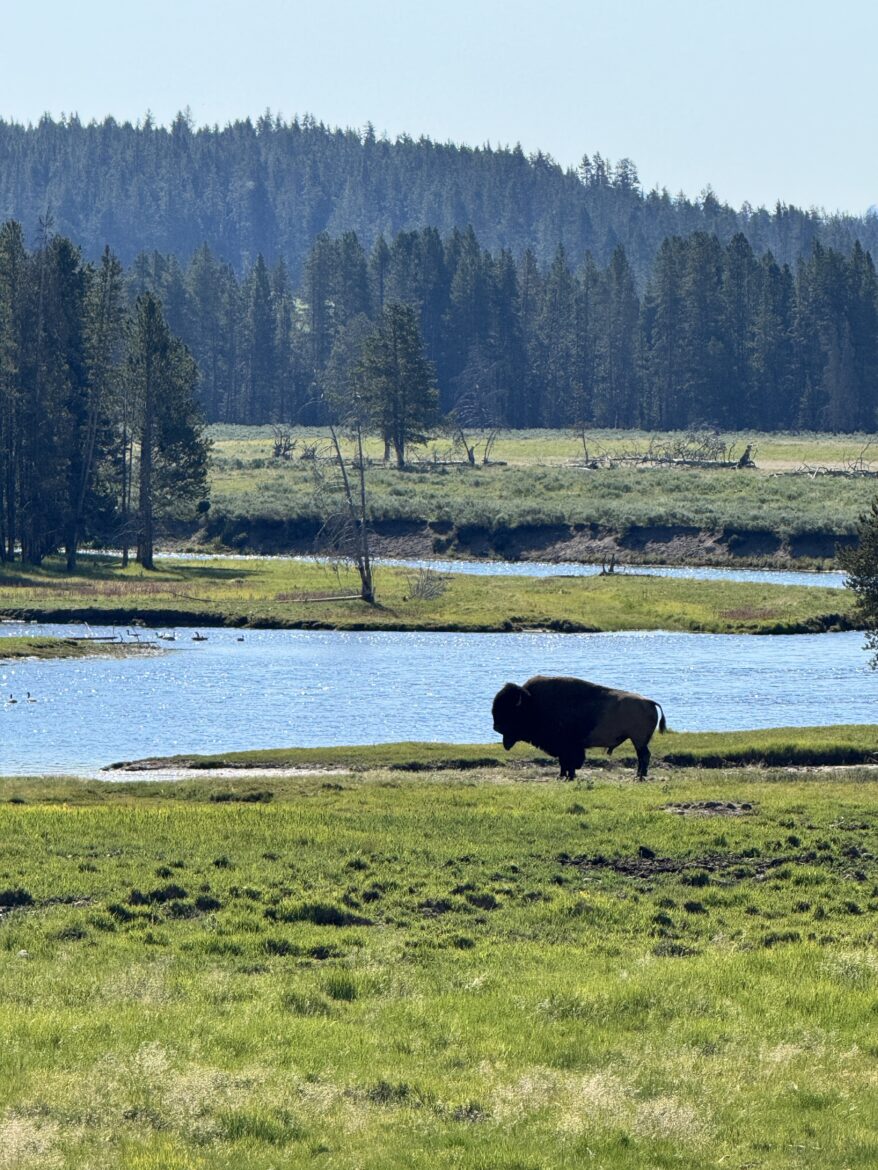
Mud Volcano also delivered our first major wildlife moment: a herd of bison moving through the area. That’s what makes Yellowstone extraordinary — the geothermal features alone would justify protecting it, the wildlife alone would justify protecting it, and Yellowstone just piles both on top of each other. One moment you’re watching boiling mud; the next, animals weighing up to 2,000 pounds are wandering through the same landscape.
A few bison facts worth knowing before you go: Yellowstone holds the largest population of wild bison on public land in the United States and is the only place in the country where bison have lived continuously since prehistoric times. They look calm. They are not tame. Stay at least 25 yards away from bison, elk, and deer — and 100 yards from bears and wolves. And that enormous sofa with horns can run several times faster than you.
Further along, Artists Paintpots packs hot springs, fumaroles, and mudpots into a compact area. The colors come from minerals and microorganisms in the thermal landscape, and the mudpots change through the year — thinner and more fluid when wet, thicker with heavier bubbles when dry. The organisms behind the colors are called thermophiles, literally “heat lovers” — microbial communities surviving in conditions that would kill almost everything else, painting bands of yellow, orange, brown, and green around the pools.
One thing photographs can’t convey: the steam moving across the landscape, the sulfur smell, the sound of bubbling mud, and the awareness that the safe route through all of it is a narrow boardwalk. Yellowstone’s boardwalks aren’t decorative suggestions. The ground around thermal features can be thin and fragile, with water near or above boiling just underneath. Stay on them. The rule protects you and the formations.
If you’re short on time and have to choose between paint pot areas, my pick is the Fountain Paint Pots on the west side over Artists Paintpots — more geyser activity plus the springs and colors, on a boardwalk loop.
Wildlife Between the Planned Stops
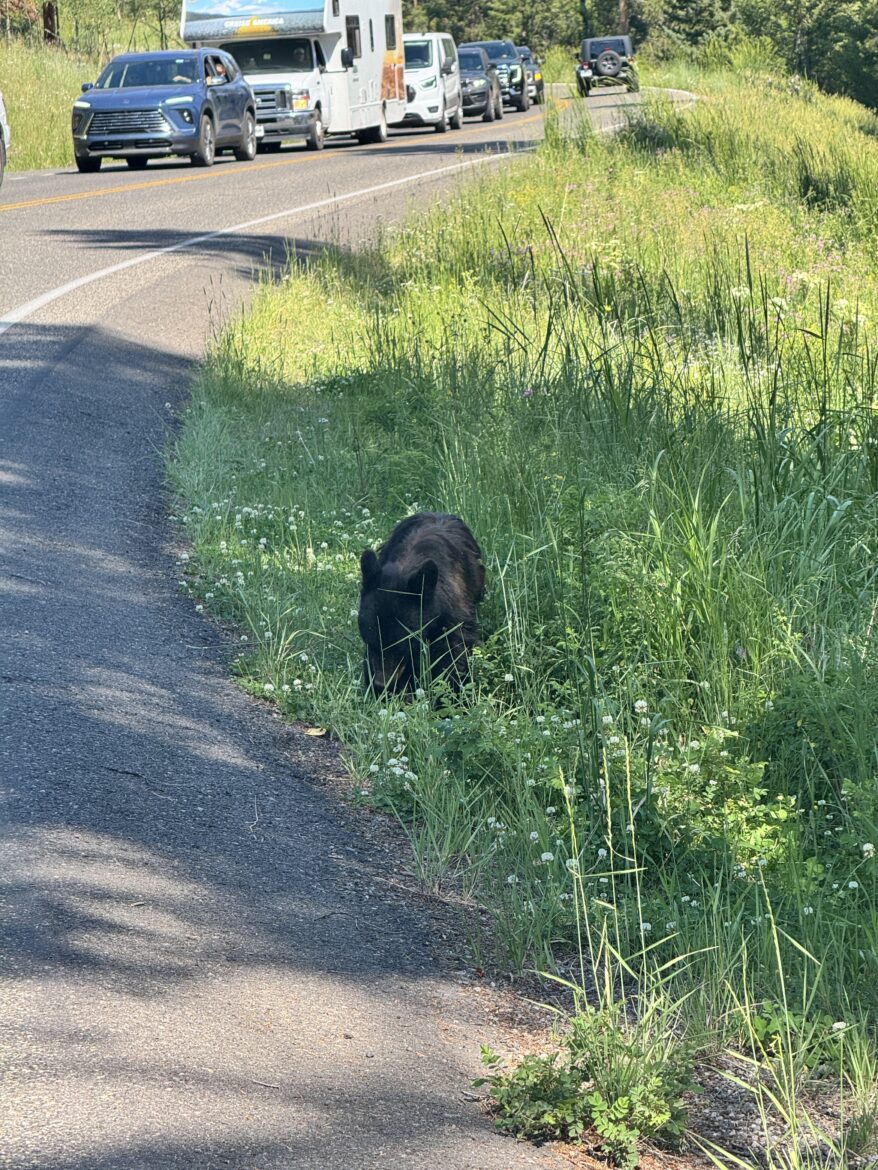
Yellowstone has a way of making its most memorable moments happen between the planned stops. Ours happened driving toward Tower Fall: cars stopped ahead, arms sticking out of windows filming something — and right there on the side of the road was a young bear, foraging on roots, completely unbothered by twenty-plus cars.
Not in the backcountry. Not after hours with a guide. Just there, being impossibly cute and instantly becoming a highlight of the trip. (For the record, it wasn’t quite a cub — more adolescent-sized. And where there’s a young bear, there’s probably a mother nearby, which is why everyone kept a respectful distance and kept moving.)
A bear sighting triggers two reactions: awe, and the realization you should stay in your vehicle and keep your distance. Park rules require 100 yards from bears and wolves. Also worth knowing: color alone doesn’t reliably identify the species — black bears can be brown or cinnamon, grizzlies vary too. Don’t play wildlife-identification games from the roadside; just enjoy it from far away.
Roadside sightings also create what Yellowstone visitors call a bear jam or bison jam: one car slows, another stops, someone points, and within minutes traffic is backed up in both directions. These jams can wreck a one-day itinerary. They’re also part of the experience. Nobody visits Yellowstone hoping traffic moves efficiently past the bear. The bear is why everyone came.
This one felt especially earned. We’d been chasing a bear sighting across national parks — in Kenai Fjords, we missed one by about a minute at the Exit Glacier visitor center because we stopped to photograph a moose. (A moose doing something cool, in our defense.) So when the National Park gods finally smiled, we took it.
Just around the corner from the bear jam is Tower Fall, dropping about 132 feet along Tower Creek, framed by tall volcanic pinnacles that gave it its name. It was one of Yellowstone’s earliest photographed and painted landmarks. It’s not the park’s tallest waterfall — that conversation belongs to the 308-foot Lower Falls of the Grand Canyon of the Yellowstone — but Tower Fall is intimate, appearing through forest and rock rather than dominating a canyon. It was one of the most unexpectedly beautiful stops of the day.
Don’t skip the stone bridge just across from the Tower Fall area, either. A dirt path before the bridge takes you down to river level — rapids, the bridge overhead, almost nobody else there. It turned into one of the most peaceful moments of the whole day.
The park holds nearly 300 waterfalls at least 15 feet tall, and the northeast side of the loop is waterfall country. Fair warning: after the fifth waterfall, you start doing triage. With almost 300 of them, you have to decide which ones get a stop and which ones get a wave from the car.
For dedicated wildlife watching, the serious answers are Hayden Valley and Lamar Valley, especially early morning or evening. Our schedule didn’t allow that. One tip we learned the hard way back in Denali: bring binoculars. Animals are often hundreds of yards off, and no phone camera covers that distance. Amy spent half the drive scanning ridgelines through ours.
The wildlife math: Yellowstone anchors the Greater Yellowstone Ecosystem, roughly 28,000 square miles of one of the largest nearly intact temperate-zone ecosystems on Earth — elk, bison, grizzlies, black bears, wolves, moose, pronghorn, bighorn sheep. Wolves were restored to the park in 1995 and 1996 after being wiped out earlier in the 20th century. But Yellowstone is not a drive-through zoo. Sightings depend on location, weather, season, time of day, and dumb luck. We got a bison herd and a bear in one day and know exactly how fortunate that was.
Yellowstone with a Dog: The Honest Version
Let’s talk about Chief, our 13-year-old adventure dog, because traveling Yellowstone with a dog changes everything about the trip.
Yellowstone allows pets only in limited developed areas. The rules: dogs must stay within 100 feet of roads, parking areas, and campgrounds, physically controlled — in a vehicle, a crate, or on a leash no longer than six feet. No hiking trails. No thermal-area boardwalks. No backcountry. And carrying your dog doesn’t create a loophole — the National Park Service explicitly prohibits pets carried in arms, strollers, or backpacks. They’ve met the people who would argue otherwise.
The rules exist for serious reasons. Thermal ground that looks solid can be a thin crust over scalding water, and the Park Service specifically notes that dogs have died after entering Yellowstone hot springs. Dogs can also attract or provoke wildlife — a domestic dog doesn’t understand that the bison by the parking lot isn’t a potential friend.
So our Yellowstone became a scenic-driving trip with carefully selected stops. We missed longer walks and some elevated views, including the full overlook above Grand Prismatic Spring. One of you always stays with the dog while the other explores, which means you experience a lot of it solo.
Amy’s verdict, straight from the episode: don’t bring the dog. Not because we don’t love Chief — he rode the entire Grand Loop, smelled sulfur aromas no dog requested, and got his big moment at Old Faithful from a permitted area near the parking lot, playing with other dogs. But so much of Yellowstone happens on boardwalks and trails, and it’s just not the same when you’re walking out there by yourself. If your trip is about hiking into the park, board the dog. If it’s a driving trip with roadside stops, it can work — but know what you’re signing up for.
Old Faithful and the Grand Finale
The western side of the loop is the Yellowstone from the postcards: enormous hot springs, crowded geyser basins, water erupting from the ground.
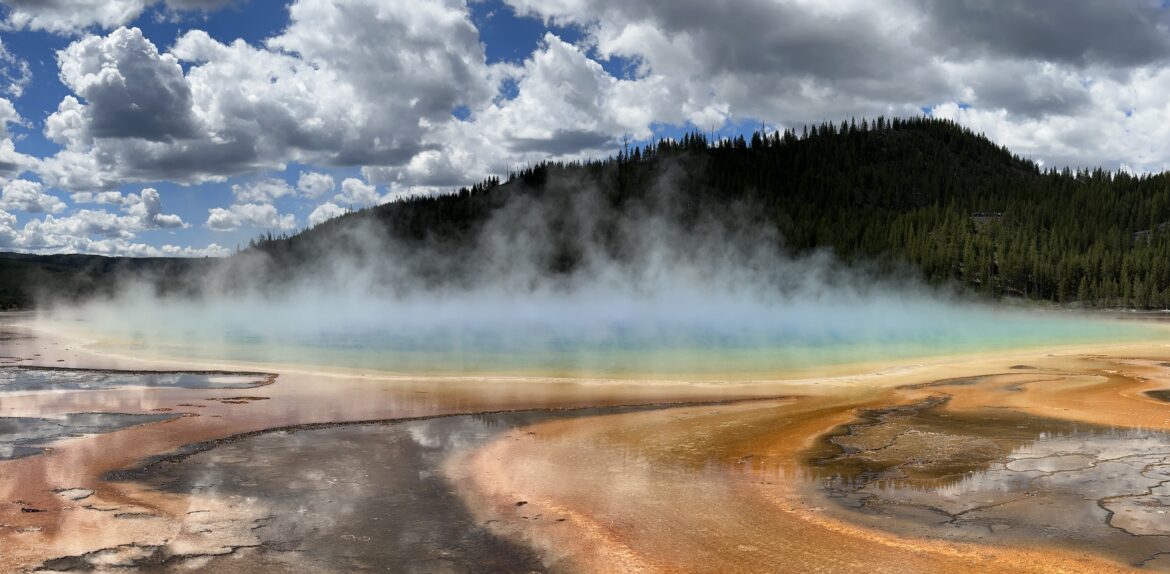
Grand Prismatic Spring is the largest hot spring in the United States and the third largest in the world — about 370 feet across and more than 120 feet deep. The deep blue center is extremely hot and clear; the bands of yellow, orange, and brown around it are thermophilic microorganisms living at different temperatures along the cooler edges. A tour guide told us the reds and yellows can only survive up to about 160°F — where the water is that vivid blue, it’s too hot for them, which is why the center stays clear. It looks unreal even standing next to it.
Here’s the practical debate: boardwalk or overlook? The boardwalk puts you right among the springs — steam, heat, color up close. The overlook off the Fairy Falls Trail gives you the famous aerial-style view from the photos. We did the boardwalk (Chief, limited time), and my take is clear: if you only have time for one, walk the boardwalk. The overlook gives you the picture; the boardwalk gives you the place.
Nearby, Norris Geyser Basin is one of the park’s hottest and most changeable thermal areas, and home to Steamboat Geyser — the tallest active geyser in the world, capable of sending water 300 to 400 feet into the air. Unlike Old Faithful, Steamboat is wildly unpredictable; major eruptions can be days or months apart. That unpredictability is exactly why Old Faithful became the celebrity.
Old Faithful isn’t the biggest geyser or the tallest. It’s famous because it’s predictable — erupting roughly every 90 minutes, with park staff calculating predicted windows based on the previous eruption’s duration. Thousands of gallons of boiling water rise more than 100 feet into the air, and the underground plumbing turned out to be more complex than the surface opening suggests — scientists found a narrow conduit and a cavern roughly the size of a small car underneath.
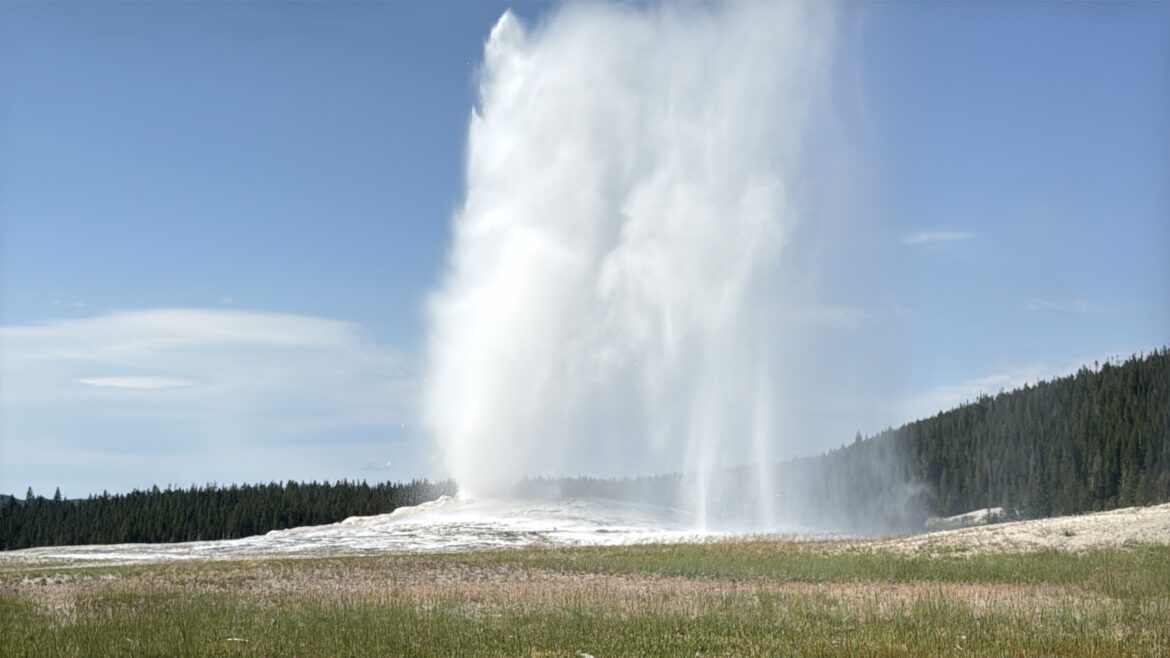
We arrived about 30 minutes before the next eruption. It exceeded expectations. My honest opinion: it’s like going to New York and skipping the Empire State Building. Do it once. If you’ve never seen a geyser erupt with hundreds of people collectively holding their breath, it’s worth the wait.
From Old Faithful we headed toward Grant Village and out the South Entrance, which feeds into the John D. Rockefeller Jr. Memorial Parkway connecting Yellowstone to Grand Teton. (Rockefeller quietly bought thousands of acres through the Snake River Land Company and eventually donated much of it — the reason that corridor exists.) And then the Tetons rose into view ahead of us, because apparently Wyoming felt the day was still short on scenery.
Can You Do Yellowstone in One Day? Our Verdict
Here’s the honest answer to the question we started with.
Yes, one day in Yellowstone is absolutely worth doing. We drove the full 142-mile Grand Loop, saw Yellowstone Lake, Mud Volcano, Artists Paintpots, Grand Prismatic Spring, Tower Fall, a bison herd, a young bear, and Old Faithful. We saw more than we reasonably expected, and it exceeded our expectations.
But one day is not enough. We skipped Mammoth Hot Springs entirely — by 12:30 we realized we weren’t even halfway through the loop and had to start sacrificing stops. We didn’t hike, didn’t wait in Lamar Valley for wolves, didn’t walk the canyon rims, didn’t watch sunrise over the lake. We covered the park; we didn’t fully experience it.
Yellowstone rewards time: early mornings for wildlife, quieter moments after the tour buses leave, hikes beyond the parking lots, and the freedom to stop without calculating remaining daylight. Our one-day visit wasn’t a complete Yellowstone trip. It was a spectacular introduction.
And sometimes an introduction is enough to make sure you come back.
Yellowstone Tips for First-Timers
- Have a plan. We didn’t — the trip was spur of the moment — and it showed by day’s end. Decide what matters most before you enter.
- Think in sectors. Geysers and Old Faithful live on the southwest side; waterfalls and scenic valleys own the northeast. You can’t be everywhere, so pick your side.
- Mileage lies. A 20-mile stretch can include mountain roads, construction, wildlife jams, and one bison with total confidence in your irrelevance. Budget far more time than the miles suggest.
- If cars are stopped, stop too. That’s how you find the bison herd and the bear. Pull fully off the road, keep your distance, and keep moving so others can see.
- Bring binoculars. Wildlife is often hundreds of yards out. Your phone can’t cover it.
- Walk the Grand Prismatic boardwalk if you only have time for one view of it. The overlook is the photo; the boardwalk is the experience.
- Short on time? Pick Fountain Paint Pots over Artists Paintpots for the most geothermal variety per minute.
- Gas up before you enter. There are stations inside the park and you’ll be grateful for them — but you’ll pay a premium for the convenience.
- Stay on the boardwalks. The ground around thermal features can be a thin crust over boiling water. This isn’t a suggestion.
- Seriously consider leaving the dog home. Yellowstone with a dog is a driving trip, not a hiking trip. If the trails and boardwalks are the point, board the pup.
Yellowstone FAQ
How big is Yellowstone National Park?
About 2.2 million acres (3,472 square miles) — bigger than Rhode Island and Delaware combined. Roughly 96% is in Wyoming, 3% in Montana, 1% in Idaho.
Can you see Yellowstone in one day?
You can drive the 142-mile Grand Loop and hit the major highlights — lake, geyser basins, waterfalls, wildlife, Old Faithful. But you’ll skip a lot, and you won’t experience it deeply. Think of it as a spectacular introduction, not a complete trip.
When was Yellowstone established?
March 1, 1872, when President Ulysses S. Grant signed the Yellowstone National Park Protection Act. It was the world’s first national park.
How many geysers are in Yellowstone?
More than 500 of the park’s 10,000+ hydrothermal features are geysers — roughly half of all active geysers on Earth.
How often does Old Faithful erupt?
Roughly every 90 minutes, though the exact interval varies. Park staff post predicted eruption windows based on the previous eruption.
Can you bring a dog to Yellowstone?
Yes, but with heavy restrictions: within 100 feet of roads, parking areas, and campgrounds only, leashed (6 feet max). No trails, no thermal boardwalks, no backcountry — and carrying your dog doesn’t exempt you. Honestly? Consider leaving them home.
Where’s the best place to see wildlife?
Hayden Valley and Lamar Valley, early morning or evening. But wildlife isn’t on a schedule — our best sightings (a bison herd, a young bear) happened roadside, between planned stops.
Do I need a plan, or can I wing it?
Have a plan. We winged it and it showed. At minimum, decide which side of the park gets your time: geysers southwest, waterfalls northeast.
Listen to the Episode
Unscaled Travel Show Ep. 170 — Yellowstone National Park
Episode page: https://www.unscaledtravelshow.com/ep-170-yellowstone-national-park/
Keep Exploring
- Ep. 14 — Visiting National Parks (with Ryan Hauck of Cody Yellowstone): planning America’s national parks, plus a conversation with the head of Cody Yellowstone about the gateway to the park.
- Interview: Ryan Hauck, Executive Director of Cody Yellowstone: the gateway town side of a Yellowstone trip — where we started ours.
- A Guide to National Park Geology for Road Trips: the forces that built the landscapes you’re driving through — pairs well with Yellowstone’s caldera.
Quick favor — if you’re enjoying the show, hit follow right now. Takes two seconds, and it’s how we keep making it. And if you’ve got another thirty seconds, leave us a rating — it matters more than you think. Take us with you: follow Unscaled Travel Show on Spotify or Apple Podcasts.