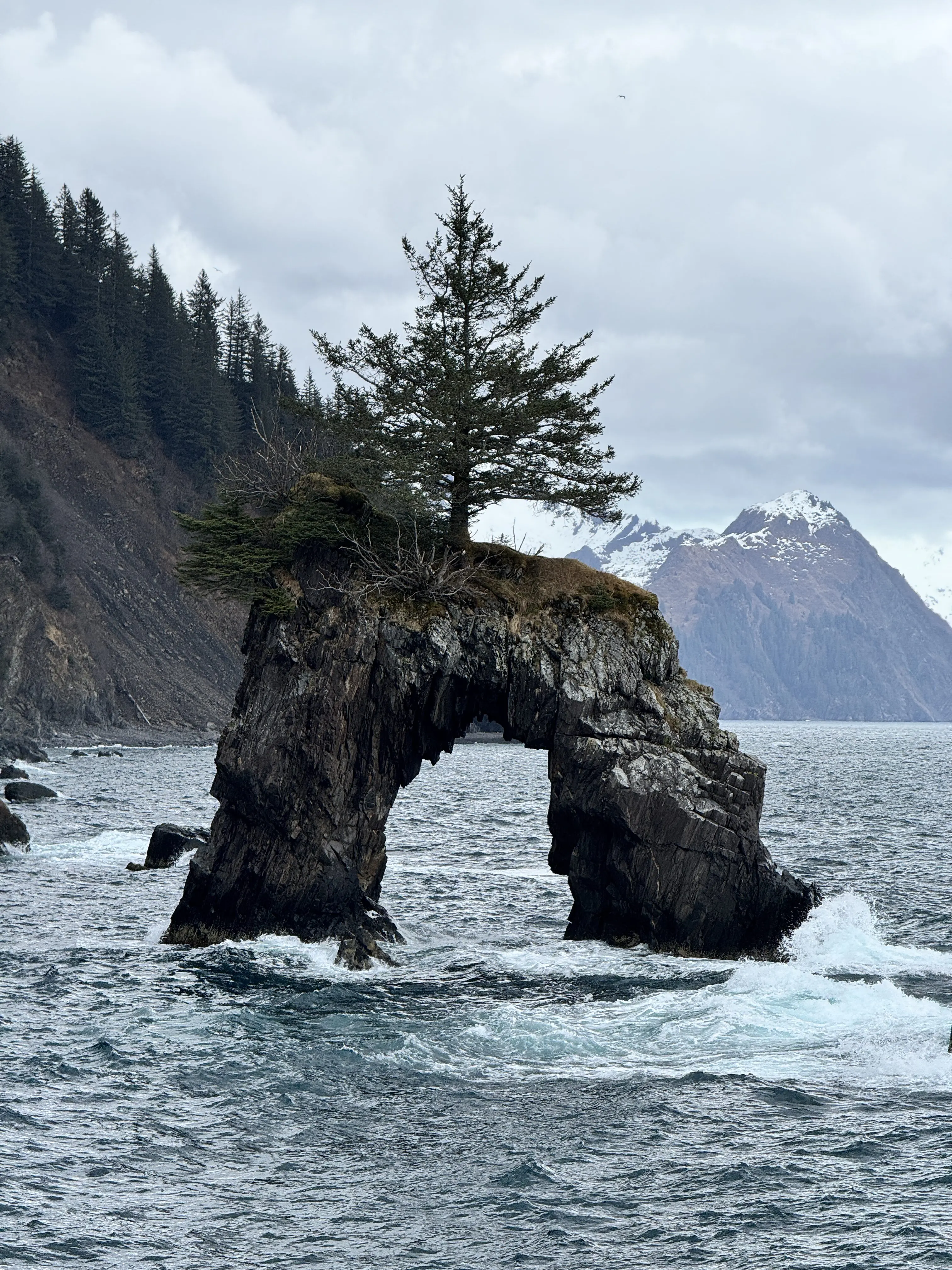
A six-hour boat day out of Seward to a tidewater glacier, plus the drive down the Kenai Peninsula that refused to follow our plan — which cruise to book, where to base yourself the night before, and what going in mid-May helps and what it costs you.
Quick favor: If you enjoy the show, follow the Unscaled Travel Show on Apple Podcasts or Spotify and leave us a rating — it’s the easiest way to help other travelers find us.
The Short Answer
Yes. Plainly yes, and we don’t say that about every stop.
Kenai Fjords is a park you experience from a boat. The fjords, the islands, and the glaciers that calve into the sea sit along a coastline that roads barely touch, so the cruise out of Seward isn’t an add-on to the park — it is the park, for most visitors. Our sailing gave us whales on the way out, bears and mountain goats on the slopes above the shoreline, and a tidewater glacier waiting at the end of Holgate Arm. By the time we tied back up in Seward harbor, the day had landed on the short list of the best travel days we’ve ever had.
Getting there took a day of its own, and that day went sideways in the best way. Both halves of the trip are below: the drive, and the water.
This Park Runs on Boats
Start with the fact that shapes every decision: there is no road into the heart of this park. Exit Glacier is the lone exception. Everything else — the coastline, the islands, the glaciers that end in the sea — you reach by boat or by air. If you drive to Seward and never get on a boat, you have visited the park’s doorstep, not the park.
Exit Glacier is the one piece you can drive to. A single road runs in toward it, and the walk out to the observation point takes roughly two hours out and back. Put that time in the schedule on purpose. We didn’t — it stayed on the list as the thing we’d get back to, and we never got back to it. Don’t repeat our version. Give Exit Glacier its own half day, either the afternoon before your cruise or the morning after, and treat the boat day as a separate commitment.
One more mid-May reality: Seward’s park visitor center wasn’t open yet when we came through. We missed it by about a week. If visitor center hours matter to your planning, check them against your dates instead of assuming summer operations.
Picking the Cruise
We booked the six-hour Kenai Fjords National Park cruise with Major Marine Tours out of Seward, and we’d book the same one again.
The honest context: six hours on a boat is normally past our limit. Four hours is usually plenty for us. But the shorter four-hour sailings don’t start running until June, and we were there in May — so the six-hour was the practical option, and it turned out to be the right one anyway. The length is what gets you all the way out of Resurrection Bay, around the cape, and up a fjord to a tidewater glacier. A shorter cruise in season is a fine trip; it just isn’t this trip.
Book the cruise ahead and let everything else on your itinerary flex around it. This is the fixed point of a Kenai Peninsula day — the drive, the detours, and dinner can all move. The sailing shouldn’t.
On board, the six-hour trip runs simply: a table is assigned to you, a pair of binoculars circulates at it, and lunch is served during the sailing. Dress for the front deck, not the cabin. Our day was cold and misty with rain starting, and we stayed outside anyway, because everything you came to see happens outside. Rain gear is not optional equipment on this coast.
How the Day on the Water Runs
The route leaves Seward harbor and crosses Resurrection Bay, and the views start immediately — there’s no warmup stretch. We ran past Fox Island, rounded Cape Resurrection, and spent time in the open water of the Gulf of Alaska before threading the Chiswell Islands on our way into the park’s fjords.
Wildlife works like this: the crew scans constantly, and every sighting sends passengers to the windows and out to the decks to watch for the next surfacing. The whales stayed well off the boat — not the show we’d hoped for — but nobody out there is performing on a schedule, ours included. We still logged whales surfacing behind the boat early on, sea lions, sea otters, and bald eagles during the day.
The destination is Holgate Glacier, where Holgate Arm dead-ends. As the boat closes in, the ice takes up more and more of the fjord: a cracked, jumbled face, blue in the splits and white across the top, running straight down into the water. While we sat in front of it, the crew picked out movement on the mountainside above the shoreline — bears working the slope, foraging. Not far off, mountain goats were picking their way across ground that looked too steep to stand on. Through binoculars they resolved into animals; to the naked eye they were dots. Whales behind us on the way in, bears and goats working the slopes, the glacier dead ahead. That’s the whole case for the six hours, in one anchorage.
Six hours after leaving, we were back at the dock. The day had a footnote: while we were out, the weather turned, and the company scrubbed the evening sailing and the next day’s departures, leaving passengers to rebook. Keep the morning after a cruise loose if you can. Coastal Alaska rewrites plans, and the people who roll with it have a better trip.
The Drive Down Is Half the Trip
The day before the cruise, we drove from Anchorage down the Kenai Peninsula, and we’d tell anyone copying this trip to treat the drive as a destination, not a transfer.
The Seward Highway carries a designation worth knowing: it’s an All-American Road, the highest designation the National Scenic Byways program gives. On paper, Anchorage to Seward is about a three-hour drive. Stop at the overlooks the way the road begs you to, and it becomes five. Let it. That arithmetic is the entire argument for the highway.
Our drive day had a loose plan — point south, maybe cross to Homer on the far coast, end at a lodge near Seward. About 80 miles out of Anchorage, the turnoff for Hope appeared and we took it — a small town where Resurrection Creek meets Turnagain Arm. Gold turned up around the creek in the 1890s and set off one of Alaska’s earliest rushes, years before the Klondike pulled everyone north. For a short stretch Hope had hotels, stores, and saloons; then the Yukon stories got bigger and the town emptied. What remains is worth the detour on its own: the mining-era schoolhouse is still in use today, and the social hall with it, and cabins from those years are scattered through town. We stayed far longer than the schedule allowed. No regrets, but the schedule noticed.
Homer died on the other side of that stop. Highway 1 narrows to effectively one lane in stretches, traffic bunched up behind the slowest car at 40, Homer was still hours off, and the math stopped working. We cut the loss and stopped in the town of Kenai instead — and we’d make that trade again. From the bluff at the edge of town you look straight across Cook Inlet at the Alaska Range, and when the air is clear, active volcanoes show along the horizon; belugas sometimes gather where the Kenai River empties into the inlet, following the salmon in. Old Town, a few blocks over, holds the Holy Assumption of the Virgin Mary Russian Orthodox Church — white walls, blue onion domes, built in the late 1800s, still an active parish and a National Historic Landmark, with services every week. The little Chapel of St. Nicholas, more than a century old, stands across the road, and historic homes and cabins fill in the blocks around them. We started the morning hunting scenery and ended it in two eras that had nothing to do with each other — a gold rush town and Russian Alaska.
The planning lesson is the one the day taught us: on this peninsula there is essentially one highway, it narrows, construction and slow traffic set your pace, and a tight itinerary loses. Build the drive day with slack in it, pick one detour, and let the rest go.
Where to Sleep
Our base for two nights was Cooper Landing, at the Kenai Princess Wilderness Lodge, and the location is the point. The lodge occupies about 50 acres of woods on a bluff over the Kenai River, and its trails loop through the trees and out along the bluff edge — we walked them the evening we arrived, which beat sitting in a car for one more hour. The property runs the usual lodge excursions (rafting and float trips on the river, pickups toward the parks) if you want them.
More important for this itinerary: Cooper Landing put us much closer to Seward for the next morning’s sailing than Anchorage would have. Our advice is to sleep on the Seward side of the peninsula the night before your cruise — Cooper Landing worked well for us — rather than adding a pre-dawn highway drive to a boat day that’s already long.
When to Go: The Mid-May Trade
We visited in the middle of May, a week ahead of Memorial Day weekend, and the trade-offs were consistent everywhere we went.
What you get: room to breathe. Towns and tours run quieter, and nothing we did felt crowded.
What you give up: the season isn’t fully switched on. The visitor center in Seward was still closed. The four-hour cruises hadn’t started. And Seward was the coldest stop of our entire Alaska trip — it snowed on us there. The landscape tells the same story that time of year: snow retreating, trees still bare, a lot of gray in a place that’s green a month later.
None of that kept the trip from working — the cruise day was a trip highlight anyway — but go in knowing which version you’re buying. If you want every tour running and every door open, come in June or later and accept the company. If quiet matters more, mid-May is a fair bargain, priced in layers and flexibility.
Kenai Fjords FAQ
Q: Is it actually worth a day of the trip? Yes. The cruise day ranks with the best travel days we’ve had anywhere — not just on this trip. If you’re anywhere near Seward in season, it’s the thing to build a day around.
Q: Can you see the park without taking a boat? Only the edge of it. Roads reach the Exit Glacier area and that’s essentially it; the fjords, islands, and tidewater glaciers are things you see by boat or by plane. If the park itself is the goal, the boat is how you get there — there isn’t a road version.
Q: Which cruise should we take, and how long is it? Major Marine Tours’ six-hour national park cruise is the one we took, and we’d book it again. In May there wasn’t really an alternative — the four-hour sailings start in June. The six hours are what get you out of the bay and up a fjord to a tidewater glacier.
Q: What wildlife should we expect? Nothing is promised, and any operator who promises is lying to you. On our sailing: bears foraging on the slope above the glacier, mountain goats, bald eagles, sea otters, sea lions, and whales. Use the shared binoculars and be patient — the goats and bears are specks until you glass them.
Q: What happens if the weather turns? Sailings get canceled, including on short notice — we watched it happen to the departures after ours, with passengers rebooking. Book the cruise early in your Seward stay if you can, and keep some slack after it.
Q: How many days do we need? Two worked for us: one for the drive down with its detours, one for the cruise, sleeping near Seward in between. Trying to stack the drive and the six-hour sailing into a single day would have wrecked both.
Keep Exploring
- Listen to the episode: Ep. 165 – Alaska: Kenai Fjords National Park, Seward
- Field Note: 48 Hours in Alaska: Anchorage, Portage Glacier & Byron Glacier
- Field Note: North to McCarthy, Alaska: The Road to Kennecott Ghost Town