Anchorage was home base for the first two days of our Alaska trip: a moose standing by the road out of the airport before we had even checked in, a downtown we liked more than we expected to, and a glacier day down the Seward Highway that we ended up driving twice. Here is how we would run those two days again — what to book ahead, what to drive yourself, and what a mid-May visit changes.
Quick favor: If you enjoy the show, follow the Unscaled Travel Show on Apple Podcasts or Spotify and leave us a rating — it’s the easiest way to help other travelers find us.
Use Anchorage as a Base, Not a Stopover
Most people treat Anchorage as the place the plane lands before the real trip starts. We gave it the first two days of our eight-day road trip, and we would keep that split. It is Alaska’s largest city and the state’s transportation hub, where nearly 300,000 people live, so nearly every route into the interior starts here anyway. The question is whether you sleep and run, or actually use the place.
Downtown argues for using it. It is a small grid of streets above the water, compact enough to cover on foot, with restaurants, shops, and mountain views packed into a few blocks. We expected a pass-through. What we found was a city we genuinely enjoyed spending time in.
The other argument is the wildlife, and it starts immediately. We got the rental car and headed out of the airport, and had been driving for maybe thirty seconds when the first moose of our lives appeared beside the road. No park entrance, no tour, no trailhead — just a moose, next to an airport road, in a city of 300,000 people. In Anchorage the wild animals are not kept in one designated corner of town. They are simply around, and the people who live there seem fine with sharing.
The practical version of all this: rent the car. Downtown does not need one, but everything else in this note does, and the car is what turns Anchorage from an arrival into a base.
Your First Hour: The Moose and Point Woronzof
About that first moose: we turned the car around to look again, and yes, we stopped right in the road to stare at it. Do not copy that part. Pull over properly. We were too excited to be sensible — neither of us had ever seen a moose in person, and the trip was about a minute old.
After dropping our bags at our bed and breakfast, Jewel Lake, we drove out to Point Woronzof. It sits out by Cook Inlet, past the end of the runway, where photographers park along the road hoping to catch jets passing low over the water. The woods behind the road are thick enough to hide an animal the size of a moose without any trouble. We watched the planes come in. Then we found more moose.
That is the whole recommendation. You do not need a booking or a plan for your first wildlife in Anchorage. You need an hour after you land and a drive to the end of the runway.
Downtown, Dinner, and the Light That Won’t Quit
Dinner on our first night taught us the one downtown lesson worth passing on: the popular places fill up. We began at 49th State Brewing, which makes its own beer, and getting a table there meant waiting close to ninety minutes. We were not willing to spend our first Alaska evening standing in a doorway. A beer and their giant Bavarian pretzel later, we gave up on the wait and ate a few blocks away at F Street Station instead.
F Street worked out well for a second reason. A few years earlier, in Mexico, Amy had talked Jeremy into eating his first oyster. At F Street he ordered fresh Alaskan oysters and tried to return the favor. She wanted no part of it. The refusal was quick and final, and the oysters stayed on his side of the table.
One honest note belongs in this section: during this opening stretch of the trip, Amy broke her ankle. Horrible luck, two days into an eight-day road trip. The trip went on — she was on the boat the next day — but it is part of the record of these two days, and we are not going to pretend the Anchorage days were flawless.
The other thing that went sideways was the light. Mid-May is midnight sun season, and we lost track of the evening completely. Your body tells you it is time to wind down; the sky disagrees, and nothing outside the window backs your body up. Decide when your day ends and end it, because the daylight will happily talk you into doing more.
The Portage Glacier Cruise: Book It, and Know What You’re Booking
Portage is about fifty miles south of downtown. Getting there means the Seward Highway, which runs alongside Turnagain Arm — a slim offshoot of Cook Inlet — with mountains crowding in on both sides. It is a good drive on its own, before any glacier enters the picture.
The cruise was one of the few things on this trip we bought in advance — the first excursion we booked, after several people, none of them knowing the others had, pointed us to it. The group meets at the Hotel Captain Cook in downtown Anchorage, and the shuttle takes you out and brings you back. Hold onto that detail, because it shapes the whole day; we will come back to it in the next section.
The boat is the Ptarmigan. At the height of the season it can hold roughly 150 passengers. On our sailing there were fewer than twenty of us. Snow was still deep on the mountains around Portage Lake, and parts of the water were still iced over — the boat cracked through it as we crossed, and a crew member at the back of the boat was hauling chunks of lake ice out of the water for anyone who wanted to hold one. Amy spotted it before Jeremy did and was already holding a chunk of that ice while he was still aiming the camera at the scheduled attraction. That turned into a pattern on this trip: he films the thing on the itinerary, and she finds the better moment happening off to the side.
The glacier hides for most of the ride out. Then the boat comes around the mountain and Portage Glacier is simply there, rising straight out of the water at the far end of the lake. We stayed in front of it for a while. There is nothing to complete out there — no summit, no finish line — and that is the point of the thing. The blue in the ice, by the way, comes from the ice itself: it is dense enough to soak up red light and throw the blue back at you.
Double Back for Byron Glacier
Here is the scheduling lesson of the whole note, and the reason our glacier day involved driving the same 50 miles twice.
When the boat docks, the shuttle takes you back to Anchorage. What the organized version does not give you is any unstructured time in Portage Valley — and the valley has a second glacier in it. So we got in the rental car and drove back down the Seward Highway we had just ridden up. We would make the same trade again, but you do not have to: if Byron Glacier matters to you, either drive yourself to Portage in the first place or plan the second run down the highway on purpose instead of discovering it the way we did.
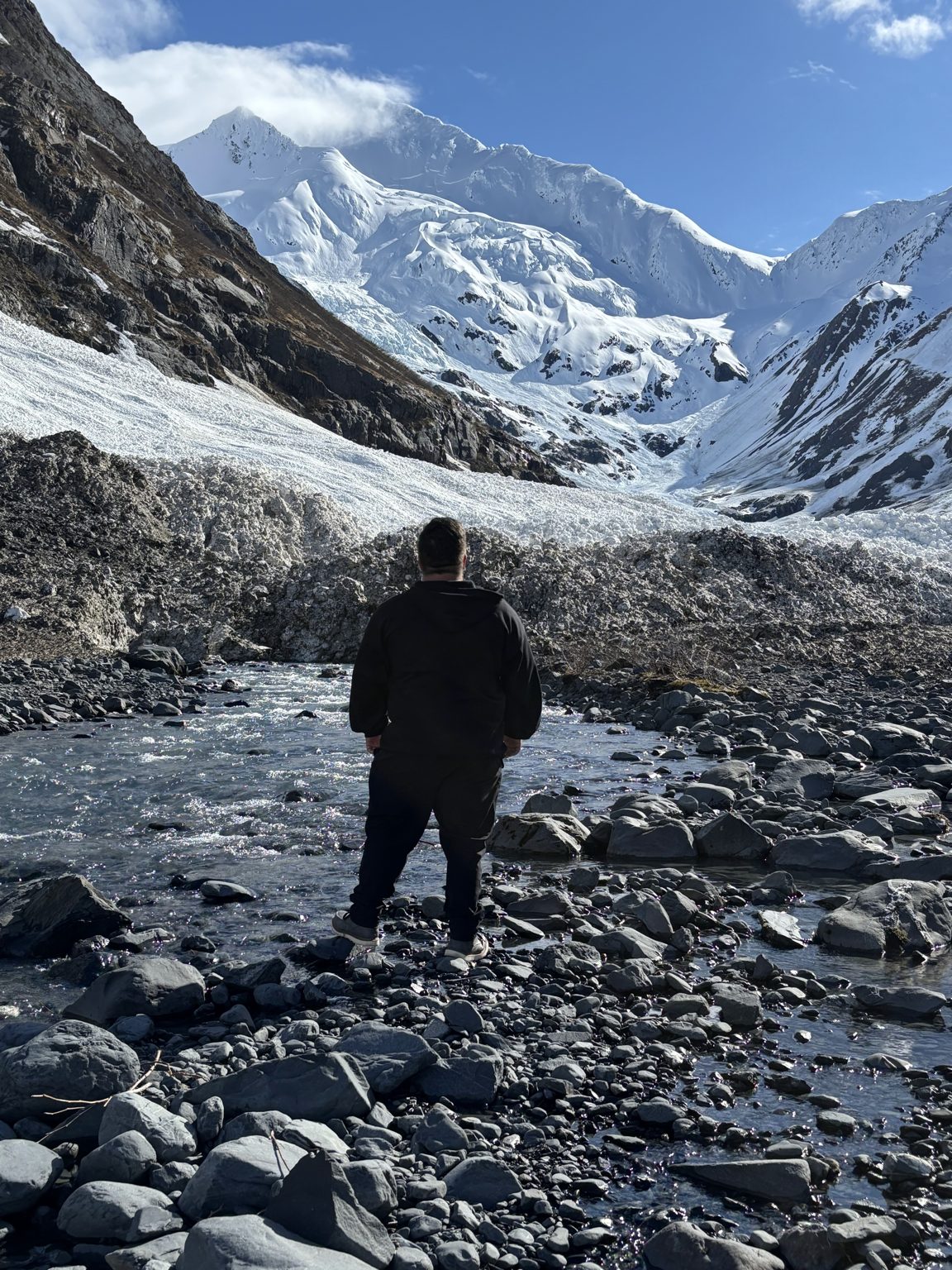
The trailhead sits near the valley’s far end, and the path tracks Byron Creek from there. It is less than a mile of mostly level walking, busy with families and dogs rather than mountaineers, before the trees open up at the observation point. Byron Glacier hangs above the valley, and in mid-May a good part of what you are looking at below it is leftover winter snowpack rather than the glacier itself. Worth knowing before you go in May: the view is real, but the snow is doing some of the posing.
Past the observation point the route keeps going as a scramble across the rocks. That part is optional and only for people who are steady on their feet. The walk to the point is the hike; the scramble is a bonus, not a requirement.
While you are in the valley, manage one more expectation: the Portage visitor center had not opened for the season when we stopped by in mid-May. It sits on the water looking less like a visitor center than like a movie villain’s headquarters, which entertained us, but a closed building is a closed building. If the visitor center matters to your day, check whether it is actually open before you build plans around it in the early season.
The Whittier Tunnel: Only If Whittier Is the Plan
The road past Portage continues toward Whittier, and getting there means the Anton Anderson Memorial Tunnel: 2.5 miles cut through Maynard Mountain, a single lane that cars share with trains, with traffic let through in timed stretches in alternating directions.
That is a commitment, not a detour. Passing through and coming back eats a real piece of a day, and Whittier was not our plan, so we skipped it and took the short Portage Lake Tunnel — about 400 feet — instead. Our rule from that day: do not wander through the big tunnel on a whim. Go through it because Whittier is the destination.
Where to Sleep
Our base for these nights was Jewel Lake, a bed and breakfast. We dropped our bags there straight from the airport and used it as our landing spot for the Anchorage days, and it did that job well.
We will be honest about the limits of that recommendation: it is one stay, and it is the only place we slept in Anchorage on this trip. If your priority is walking out the door to dinner, downtown is the other natural base — the restaurants are concentrated within a few blocks, and we covered the grid on foot every time we were in it. Pick based on which matters more to you, a quiet landing or a walkable dinner.
When to Go: The Mid-May Trade
We were there in mid-May, in the seam between winter and spring, and the trade-offs were clear by the end of day two.
What mid-May gives you: clear roads, thin crowds, and a boat built for about 150 people carrying fewer than twenty. Ice was still on Portage Lake, which we counted as part of the show rather than a problem.
What mid-May costs you: things open late. The visitor center was still closed for the season, snow was still covering the ground below Byron Glacier, and the whole area had the feel of a place getting ready rather than a place in full swing.
And whatever month you choose, if your trip touches the midnight sun, build your own ending to the day. The light will not give you one.
Anchorage FAQ
Q: Is Anchorage worth two days, or just the night you land? Two days. One for the city itself — downtown, Point Woronzof, a real dinner — and one for the Portage day. It was the base for days one and two of our eight-day trip, and we would keep that split.
Q: Can you do the Portage cruise and Byron Glacier in the same day? Yes — we did exactly that. Just know the cruise shuttle goes back to Anchorage when the boat docks, so seeing Byron meant driving the Seward Highway a second time. Driving yourself to Portage makes it a single trip.
Q: Do you need to book the Portage cruise in advance? We did, and we would again. It was the first purchase we made for the entire trip, on the strength of several people recommending it independently of one another. Our mid-May boat was nearly empty, but a vessel that can carry about 150 people is a different story at peak season.
Q: How hard is the Byron Glacier walk? Not hard. Under a mile, mostly flat, and busy — expect families and dogs on it. The rock scramble past the observation point is the only part that asks anything of you, and it is optional.
Q: Is the Whittier tunnel worth doing while you’re down there? Only if Whittier is the point. It is one lane shared with trains, traffic moves in timed alternating stretches, and the tunnel runs 2.5 miles through the mountain. As a side quest on a Portage day, it takes over. We skipped it.
Keep Exploring
- Listen to the episode:Ep. 164 – Alaska: Anchorage, Portage Glacier & Turnagain Arm
- Field Note: Kenai Fjords National Park, Alaska: Is It Worth Visiting?
- Field Note: Fairbanks to Denali, Alaska: Sled Dogs, a Sternwheeler & the 30% Club